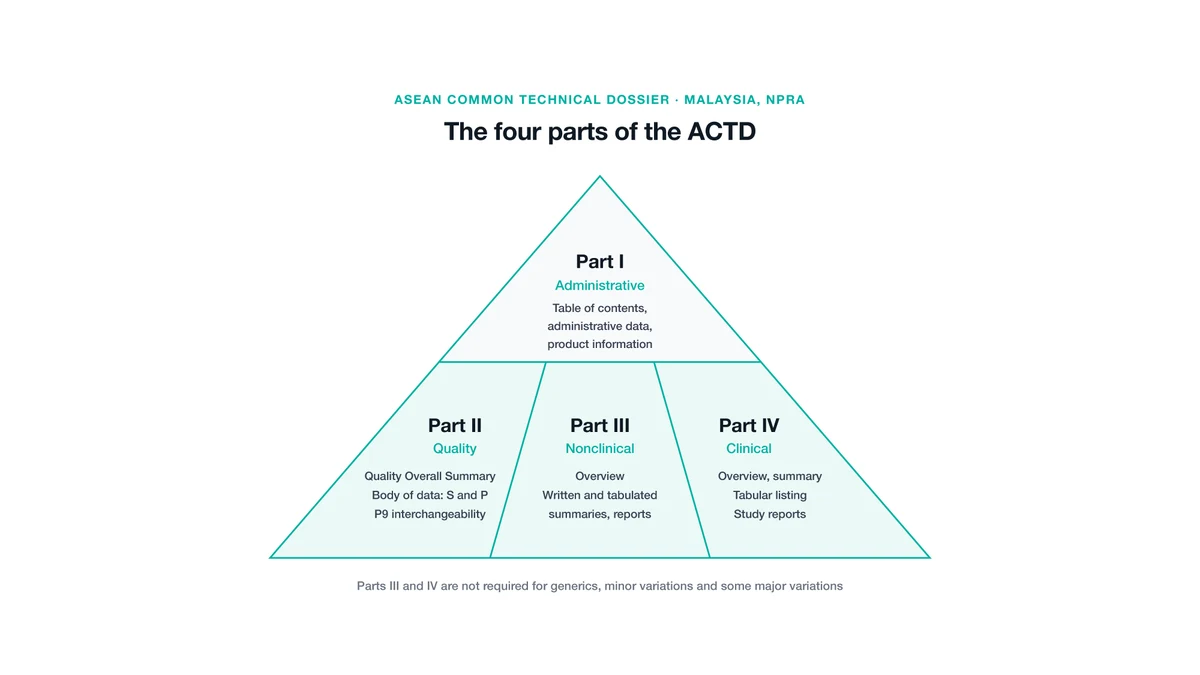
Malaysia registers medicines on the ASEAN Common Technical Dossier (ACTD), which has four parts instead of the CTD's five modules. Parts II, III and IV correspond to Modules 3, 4 and 5 (quality, nonclinical, clinical). Module 1 becomes Part I - table of contents, administrative data and product information. Module 2 has no single counterpart part: its overviews and summaries are redistributed: the Quality Overall Summary opens Part II, the nonclinical overview and summaries go to Part III, and the clinical overview and summary go to Part IV. For generics, minor variations and some major variations, Parts III and IV are not required at all. The work that remains is Part I, which is genuinely new, and the Malaysian technical gaps - most often stability data to ASEAN Climate Zone IVb.
Most European teams approach this as a reformatting exercise: same content, different folder tree, hand it to a junior regulatory associate. That framing is why ACTD conversions run late. The ACTD is not a renamed CTD - it reorganises the dossier around a different logic, and it asks for a small set of documents that simply do not exist in an EU submission. The good news is that the arithmetic usually works in your favour, especially for generics.
What the ACTD is, and what Malaysia actually requires
The ACTD is the regional dossier format agreed across ASEAN and used by Malaysia, Singapore, Thailand, Indonesia, the Philippines, Vietnam and the other member states. Its four parts are:
- Part I - Table of Contents, Administrative Data and Product Information. Section A: Introduction. Section B: the overall ACTD table of contents. Section C: documents required for registration, such as application forms, labelling, product data sheet and prescribing information.
- Part II - Quality. Section A: table of contents. Section B: Quality Overall Summary. Section C: Body of Data (drug substance, then drug product). Section D: key literature references.
- Part III - Nonclinical. Section A: table of contents. Section B: Nonclinical Overview. Section C: written and tabulated summaries (pharmacology, pharmacokinetics, toxicology). Section D: study reports.
- Part IV - Clinical. Section A: table of contents. Section B: Clinical Overview. Section C: Clinical Summary. Section D: tabular listing of all clinical studies. Section E: clinical study reports.
On the Malaysian side, the main body of NPRA's Drug Registration Guidance Document (DRGD) states that its scope covers submission of registration applications "which is based on the ASEAN Common Technical Dossier / Requirements (ACTD / ACTR), where applicable." Note what that sentence does and does not say. It anchors Malaysian submissions to the ACTD; it does not describe a parallel ICH CTD submission route. You will find third-party pages claiming Malaysia "accepts both CTD and ACTD" - the DRGD main body does not say that, so treat it as a question to confirm for your route rather than a fact to plan around.
The mapping table
Where each piece of an ICH CTD dossier lands in the ACTD:
| ICH CTD | Goes to | Note |
|---|---|---|
| Module 1 - regional administrative | Part I, Section C | Content is replaced, not moved: EU-specific forms and labelling give way to Malaysian ones |
| Module 2.3 - Quality Overall Summary | Part II, Section B | Opens the quality part |
| Module 2.4 - Nonclinical Overview | Part III, Section B | Opens the nonclinical part |
| Module 2.5 - Clinical Overview | Part IV, Section B | Opens the clinical part |
| Module 2.6 - nonclinical written and tabulated summaries | Part III, Section C | Pharmacology, pharmacokinetics, toxicology |
| Module 2.7 - clinical summary | Part IV, Section C | Biopharmaceutics, clinical pharmacology, efficacy, safety, synopses |
| Module 3 - quality | Part II, Section C | Body of Data: drug substance (S), then drug product (P) |
| Module 4 - nonclinical study reports | Part III, Section D | Often not required - see below |
| Module 5 - clinical study reports | Part IV, Section D and E | Tabular listing plus the reports; often not required - see below |
Why Module 2 is the hard part
In the CTD, Module 2 is a single place where every overview and summary lives together. The ACTD has no such module. Instead, Module 2 is redistributed: the Quality Overall Summary opens Part II, the nonclinical overview and its written and tabulated summaries open Part III, and the clinical overview and clinical summary open Part IV.
The consequence is more than cosmetic. A Module 2 written as one continuous document, with internal cross-references between the quality, nonclinical and clinical summaries, has to be split into three documents that each stand alone. Cross-references that pointed inside Module 2 now point across parts, and every table of contents - there is one per part, plus the overall one in Part I - has to be rebuilt against the new structure. This is editorial work on regulatory content, which means it needs someone who can tell what may be re-cut and what may not. It is the single most common place where a "simple reformat" turns into a three-week job.
Part I: the section you cannot copy from anywhere
Part I is where your EU dossier has the least to offer, because Module 1 is regional by definition. Expect to create, not convert:
- Application forms filed through NPRA's QUEST online system.
- Labelling and package insert to Malaysian requirements.
- Product data sheet and prescribing information, including a general introduction to the product with its pharmacological class and mode of action.
- Particulars of the product owner and manufacturer - the DRGD carries a dedicated appendix for this supplementary documentation.
- Valid GMP evidence for your manufacturing sites, and a Certificate of Pharmaceutical Product (CPP) where applicable.
One definition worth reading closely, because it decides who signs what: the DRGD, borrowing the ACTD and ACTR glossary, defines the Product Owner as the person, company or entity that is the legal or registered owner of the product formulation and/or process, with whom the marketing authorisation holder has a contract. In other words the framework itself assumes the owner of the formulation and the holder of the registration can be two different companies, joined by contract. That is the regulatory basis for the structure most European manufacturers actually need, and we unpack it in can a foreign manufacturer hold a Malaysian registration.
Part II: S and P numbering, and the P9 surprise
Part II Section C, the Body of Data, is organised as S for drug substance and P for drug product - S1 general information, S2 manufacture, S3 characterisation, S4 control of drug substance and so on; then P1 onwards for the finished product. A CTD Module 3 maps onto this cleanly at the level of content.
The item that surprises people is the last one: P9, Product Interchangeability. It asks for equivalence evidence - a comparative dissolution study in vitro, or a bioequivalence study in vivo, as required. In a CTD, bioequivalence data normally sits in Module 5 as a clinical study. In the ACTD it is requested inside the quality part. For a generic manufacturer this is the difference between "our BE study is in the clinical module we were told we do not need" and a clean submission, so it is worth checking early.
Parts III and IV: what generics can leave out
This is the part of the ACTD that pays for the conversion work, and it is stated plainly in the ACTD itself:
- Part III (nonclinical) and Part IV (clinical) are not required for generic products, minor variation products and some major variation products.
- For new chemical entities, biotechnological products and other major variations, the study reports within those parts may not be required if the original product is already registered and approved for marketing authorisation in reference countries. The authority asks for specific study reports where it needs them.
Read that second point next to the first: the ACTD has reliance built into its structure, not only into Malaysia's separate fast-track routes. If your product is approved in a reference country, the expectation is that the full study reports may not need to travel - the overviews and summaries do. For a mid-sized European manufacturer this is usually the difference between an intimidating dossier project and a manageable one.
The gaps a European dossier usually has
Three things are missing from most EU dossiers, and none of them are format problems:
| Gap | What it means |
|---|---|
| Stability data to ASEAN Climate Zone IVb | European data is generated for a temperate zone; Malaysia sits in Zone IVb (hot and humid). The DRGD treats Zone IVb data as the expectation and provides for exemption requests to be filed as a minor variation (MiV-PA) through QUEST - which tells you that exemption is a formal application, not an assumption. This is the most common reason an otherwise complete dossier stalls. |
| Certificate of Pharmaceutical Product | A CPP in the expected form, from the competent authority of the exporting country. Straightforward, but it has a lead time you do not control. |
| GMP evidence NPRA recognises | EU-GMP status generally fits, since Malaysia and EU authorities both operate within the PIC/S framework - but confirm the exact documents wanted for each site named in the dossier. |
Note the sequencing risk in the first row. Zone IVb studies are real laboratory time. If they are discovered during dossier assembly rather than during planning, they set the whole launch back, and no amount of regulatory skill compresses them.
How this interacts with the fast-track route
Malaysia's FRP recognition pilot, live since May 2026, gives FDA and EMA-approved products an accelerated review - and its central condition is that the dossier be identical to what the reference agency approved, with nothing added, modified, substituted or omitted. An ACTD restructuring is, by definition, a change to how the dossier is organised.
How the sameness requirement of the recognition route sits with the ACTD structure is exactly the kind of question to put to NPRA in writing before you choose your route - the answer changes what you prepare and in what order. We flag it because it is the practical fork for any EU manufacturer with a fresh EMA approval, and because published guidance does not spell it out. Our guide to the FRP recognition pilot covers the route's other conditions and the three-month filing window.
A working order of operations
- Classify the product first - generic, new chemical entity, biologic, variation. This decides whether Parts III and IV are in scope at all, and it is the single biggest driver of effort.
- Check the Zone IVb position before anything else, because it has the longest lead time and may require an exemption application.
- Locate your equivalence evidence and plan for it to sit at P9 in Part II.
- Build the Malaysia-specific Part I package against the DRGD, including product owner and manufacturer particulars, GMP evidence and CPP.
- Dismantle Module 2 into three stand-alone summaries, then rebuild every table of contents.
- Map Module 3 to Part II S and P numbering; keep Module 4 and 5 material ready even where reports are not required, because the authority may ask for specific reports.
- Have the holder file through QUEST - and note the DRGD's administrative traps, such as payment being due within 30 days of approved screening, failing which the application is rejected.
RHMI acts as your Marketing Authorisation Holder in Malaysia and runs the submission end to end: classifying the product to establish what the ACTD actually requires, building Part I, restructuring the dossier into ACTD parts, filing through QUEST and handling NPRA's queries. Because we hold the registration locally, you do not need a Malaysian entity - and your dossier ownership stays documented as yours.
Frequently asked questions
What is the ACTD?
The ASEAN Common Technical Dossier, the regional submission format used across ASEAN including Malaysia. Four parts: Part I table of contents, administrative data and product information; Part II quality; Part III nonclinical; Part IV clinical. NPRA's DRGD states that registration applications are based on the ACTD and ACTR, where applicable.
How does the ICH CTD map to the ACTD?
Parts II, III and IV correspond to Modules 3, 4 and 5. Module 1 becomes Part I, with its content replaced by Malaysian equivalents. Module 2 has no single counterpart part - the Quality Overall Summary opens Part II, the nonclinical overview and summaries go to Part III, and the clinical overview and summary go to Part IV.
Do generics need the nonclinical and clinical parts?
No. The ACTD states Part III and Part IV are not required for generic products, minor variations and some major variations. For NCEs and biotechnological products, study reports in those parts may not be required where the original product is already registered and approved in reference countries.
Can I submit my ICH CTD dossier to NPRA as it is?
Plan on restructuring. The DRGD main body is built on the ACTD and ACTR and does not set out an ICH CTD submission route, so the ACTD structure is what NPRA expects. Confirm the position for your specific route with NPRA - especially on reliance routes, where the reference agency's dossier must stay identical.
What does ACTD Part II have that CTD Module 3 does not?
P9, Product Interchangeability: equivalence evidence by comparative dissolution in vitro or a bioequivalence study in vivo, as required. In the CTD that evidence usually sits in Module 5, so generic manufacturers should confirm early where their BE data will be presented.
What extra documents does Malaysia require that are not in an EU dossier?
The Part I administrative set: QUEST application forms, Malaysian labelling and package insert, product data sheet and prescribing information, particulars of the product owner and manufacturer, valid GMP evidence and a CPP where applicable. Technically, stability data to ASEAN Climate Zone IVb is the most frequent addition.
You might also find useful
- Registering Chinese and Indian Pharmaceuticals in Malaysia: GMP Status Decides Your Route
- Drug registration services in Malaysia: RHMI files and defends your dossier with NPRA
- Malaysia Market Entry for EU Pharma Manufacturers - routes, MAH and timelines
- Fast-Track Registration 2026: Register Your FDA/EMA-Approved Drug Faster
- Sources:
- ACTD - Organisation of the Dossier (Parts I-IV, and the statements that Part III and Part IV are not required for generics, minor variations and some major variations), hosted by NPRA: npra.gov.my (PDF)
- ACTD Part II: Quality (S and P numbering, P9 Product Interchangeability): npra.gov.my (PDF)
- ACTD Part III: Nonclinical and Part IV: Clinical: Part III (PDF) · Part IV (PDF)
- NPRA - Drug Registration Guidance Document (DRGD), 3rd Edition (scope based on ACTD/ACTR, Zone IVb exemption via MiV-PA, product owner definition, screening and payment rules): npra.gov.my
- NPRA - ASEAN guidance documents: npra.gov.my
- Editorial note: This article is general business and regulatory information for manufacturers evaluating Malaysia. It is not legal or regulatory advice. The DRGD is revised frequently - the current edition at the time of writing is the 3rd Edition, 12th Revision (July 2026). Confirm dossier requirements, formats and exemptions against the current DRGD and ACTD before acting.